




The Predator REVO is the carbon fiber shaft that redefined what a pool cue shaft can be. Since its debut, it has become the benchmark against which every other low deflection shaft is measured, and for good reason. Its ferruleless construction, proprietary carbon fiber layup, and unmatched consistency have made it the choice of touring professionals and serious amateur players alike. Whether you are shooting for the first time with carbon fiber or upgrading from a Predator 314-2 or Z3, this guide will walk you through everything you need to know: diameters, deflection science, bridge style compatibility, and what to expect when you make the switch.
If you want a quick side-by-side against competing carbon shafts, check out our full Predator REVO vs Mezz Ignite vs Cynergy carbon shaft comparison. For a broader look at the Predator lineup, the Predator Cues Buying Guide is an excellent place to start.
The REVO Revolution in Pool Shafts
Before the REVO, low deflection was achieved primarily by thinning the front taper of a maple shaft and replacing the dense wooden ferrule with a lightweight synthetic one. Predator’s own 314-2 and Z3 shafts used this approach effectively, and both remain strong performers. But wood has a hard ceiling: it expands and contracts with humidity, it warps under sustained stress, and no two pieces are identical at a microscopic level.
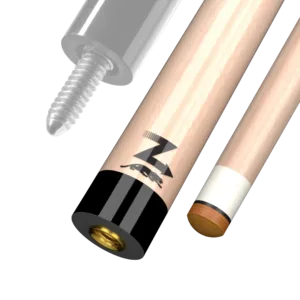
Carbon fiber removes all of those variables. The Predator REVO shaft is built around a proprietary multi-layer carbon fiber tube. That tube is stiffer, lighter at the front end, and more consistent than any wood shaft can be. Predator’s ferruleless design means there is no dense ferrule mass to create unwanted pivot during a shot, which is precisely where deflection originates. The result is Predator’s lowest front-end mass and highest stiffness rating across their entire shaft lineup, producing exceptional low deflection, ultra-efficient energy transfer, and effortless spin generation at both high and low cue ball speeds.
One number that tells the story clearly: the REVO delivers 5 to 10 percent more accuracy compared to Predator’s own third-generation spliced wood shafts. Against a standard maple shaft, the advantage is even more pronounced. That is not marketing language. That is the measurable difference that explains why REVO shafts now appear on the tables of professional players across multiple tours.
Understanding Predator REVO Diameters: 11.8mm vs 12.4mm vs 12.9mm
The REVO is available in three tip diameters, and choosing the right one is the single most important decision you will make when purchasing the shaft. Each diameter plays differently, and the best choice depends on your bridge style, stroke habits, and what you are coming from.
Predator REVO 12.9mm: The Traditional Feel Option
The Predator REVO 12.9mm is the most forgiving of the three diameters. Its tip size sits closest to what most players are used to on a standard maple shaft, which typically measures between 12.75mm and 13mm. If you are transitioning from a 314-2 or a conventional wood shaft, the 12.9mm is the smoothest path into carbon fiber territory. The larger contact patch gives you a little more margin on off-center hits, which can be reassuring while you are recalibrating your aim system for low deflection.
Deflection on the 12.9mm is still dramatically lower than any wood shaft, but it is the highest of the three REVO options. For players who prefer a traditional stroke feel and are not yet ready to commit to a thinner tip, this is the recommended starting point.
Predator REVO 12.4mm: The Balanced Middle Ground
The Predator REVO 12.4mm is the shaft that sits squarely between maximum forgiveness and maximum performance. It offers meaningfully lower deflection than the 12.9mm while still providing a comfortable tip size for players who have not played extensively with sub-12mm shafts. Many intermediate to advanced players land here permanently, finding that the 12.4mm gives them everything they need without the adjustment demands of the thinnest option.
If you have already spent time on a 314-3 or a Z3 and are comfortable with a slightly thinner profile, the 12.4mm is a natural next step.
Predator REVO 11.8mm: Maximum Low Deflection
The Predator REVO 11.8mm is where the shaft’s engineering really pushes its limits. At 11.8mm, the front-end mass is at its absolute minimum, and the deflection figures are the lowest Predator has ever produced on a playing shaft. This is the version you will see most often on professional tables.
The tradeoff is precision demand. A thinner tip means a smaller contact patch, which is more punishing of sloppy technique. Players who shoot with consistent, compact strokes will love the 11.8mm. Players still working on their fundamentals may find it less forgiving than they would like. That said, once you adapt, the 11.8mm’s performance ceiling is extraordinary.
How Bridge Style Determines Your Best REVO Diameter
One topic that gets almost no attention in most shaft guides is how your bridge style should influence your diameter choice. It matters more than most players realize.
Open Bridge Players
If you predominantly use an open bridge, the shaft rests in the V-groove between your thumb and index finger. There is no rail contact on the sides of the shaft near the tip, which means the shaft can move laterally more easily during the stroke. Open bridge players typically generate more natural English and benefit from a shaft with a slightly larger diameter, as the wider tip provides a more stable, predictable contact point. The 12.9mm or 12.4mm tends to suit open bridge players best, offering a balance of low deflection and hitting security.
Closed Bridge and Draw-Heavy Players
Players who use a closed bridge wrap their index finger over the shaft, creating a tighter channel with consistent lateral support. This steadier guide rail allows for a more precise delivery, which makes the tighter tip of the 11.8mm or 12.4mm easier to control. Closed bridge players who hit a lot of draw shots and favor extreme sidespin will also find that the 11.8mm’s reduced deflection makes those shots significantly more predictable, since the cue ball travels closer to the intended path without as much aim compensation.
A useful rule of thumb: if you currently aim with a significant squirt offset built into your mechanics, moving to the 11.8mm will require the most aim recalibration. The 12.9mm will require the least. Start where your comfort level is, and work thinner as your stroke adapts.
The Science of Low Deflection: Why REVO Outperforms Wood
Deflection, often called squirt, is the sideways deviation of the cue ball from the intended line of aim when you apply sidespin. It happens because striking the cue ball off-center creates a lateral force, and the front end of the shaft bends in response. The heavier and more flexible that front end is, the more the shaft bends and the more the cue ball deflects.
Every design decision in the REVO is aimed at reducing that front-end mass and increasing stiffness simultaneously. The carbon fiber tube achieves stiffness-to-weight ratios that maple cannot approach. The ferruleless construction eliminates the single heaviest concentrated mass point in a traditional shaft. The result is a shaft that bends less, bends more predictably, and returns to center faster than wood.
Compare the REVO to the Predator Z3, which is itself one of the better low deflection wood shafts on the market. The Z3 uses a thin-walled construction and lightweight ferrule to reduce squirt, and it performs well. But the REVO still outperforms it on deflection metrics and, critically, on consistency shot to shot. Wood is subject to micro-variations in grain density and moisture content that shift its behavior in subtle ways. Carbon fiber is not. Every REVO shaft of the same spec plays identically to every other.
That consistency point is worth underscoring: buy two REVO shafts of the same diameter and joint type, and they will play identically. That is something no wood shaft manufacturer can promise.
For players interested in how the REVO pairs with Predator’s break lineup, our Predator BK Rush Break Cue review covers that side of the table.
Feel, Sound, and Transition: What to Expect When Switching to REVO
Switching from a maple shaft to the REVO is not just a performance upgrade. It is a sensory shift, and being prepared for it will make your transition far smoother.
The Acoustic Signature
Carbon fiber hits differently than wood, and you will hear it immediately. Where a maple shaft produces a soft, warm thud at contact, the REVO delivers a sharper, crisper crack. Many players describe it as a cleaner, more precise sound. Over time, this acoustic signature actually becomes a useful feedback tool: a clean, sharp crack indicates a well-centered hit and proper cue speed. A dull or muffled sound usually signals that something was off in your delivery. Your ear becomes a diagnostic instrument.
The Feel at Contact
The REVO transmits vibration differently than wood due to its higher stiffness. Some players initially describe the feel as slightly harder or more rigid. This is not a negative, but it is different. The feedback loop is more immediate and direct. After a few sessions, most players find this directness informative rather than jarring, and the overall hit settles into something that feels precise and authoritative rather than soft and forgiving.
Aim Adjustment and the Transition Period
If you have been compensating for the squirt of a wood shaft, you will need to recalibrate your aim. With the REVO, less aim offset is required because the cue ball travels much closer to your intended line. Players who shoot with ghost ball or aim system methods often adapt quickly. Players who rely on feel and have unconsciously baked squirt compensation into their mechanics take a little longer, typically two to four weeks of focused practice.
The 12.9mm is strongly recommended for anyone transitioning directly from maple. Its deflection profile is closer to a high-end wood shaft than the 11.8mm is, which reduces the recalibration demand. Once you have adjusted, moving to a thinner REVO becomes an incremental step rather than a leap.
Maintenance: Dramatically Simpler Than Wood
One of the most underappreciated advantages of the REVO is what you do not have to do. No sealing. No burnishing. No conditioning with shaft wax. Carbon fiber does not absorb moisture, does not warp, and does not need seasonal maintenance. A quick wipe with a microfiber cloth keeps it playing at full performance. The REVO is also backed by Predator’s limited lifetime warranty, which adds another layer of confidence to the investment.
The Victory Soft Tip
All REVO shafts ship with the Predator Victory Soft Tip installed as standard. This is a deliberate pairing. Given the REVO’s high stiffness and efficient energy transfer, a softer tip helps absorb the impact and extend dwell time at contact, giving you better grip on the cue ball for spin shots. The Victory Soft Tip is engineered to compress and mushroom less than generic soft tips, which means longer service life without compromising feel. It is an excellent match for the carbon fiber platform.
REVO Joint Options: Radial vs Uni-Loc
The REVO is available with both radial pin and Uni-Loc Quick Release joint configurations. If your butt uses the Uni-Loc system, which is standard on most modern Predator playing cues, the Uni-Loc REVO shaft snaps in and locks securely with a quarter turn. If you are pairing the REVO with a traditional cue, the radial joint version offers broad compatibility. Always confirm your butt’s joint type before ordering to ensure a proper fit.
Conclusion: Choosing Your Perfect REVO Shaft
The Predator REVO is the most proven carbon fiber shaft in the game, and choosing between its three diameters comes down to a clear framework:
- 12.9mm: Best for open bridge players and anyone transitioning from maple. Most forgiving, easiest adjustment period.
- 12.4mm: The balanced all-rounder. Excellent low deflection without the precision demands of the thinnest option. Great for intermediate to advanced players.
- 11.8mm: Maximum performance. Best for closed bridge players, draw-heavy shooters, and anyone whose technique is already dialed in. The choice of professionals.
All three diameters share the same carbon fiber platform, the same ferruleless construction, the same warranty, and the same low-maintenance advantage over wood. The difference is in how much aim adjustment your current mechanics require and how thin a tip you are comfortable shooting with.
Pro Cue Shop stocks the full range of authentic Predator REVO shafts, including all three diameters and both joint configurations, with fast worldwide shipping. Browse our complete pool cue shafts collection to compare options, or explore our guide on how to choose a pool cue shaft if you are still weighing your options.
If you want to complete your Predator setup, the Predator Air Rush Teal Jump Cue pairs beautifully with a REVO playing shaft and rounds out a full professional-grade cue kit.
Frequently Asked Questions: Predator REVO Shaft
Which Predator REVO shaft is best for beginners?
The 12.9mm is the recommended starting point for players new to low deflection or carbon fiber shafts. Its larger diameter and more forgiving deflection profile reduce the adjustment burden while still delivering a significant performance upgrade over wood.
How much does the Predator REVO reduce deflection compared to a maple shaft?
The REVO delivers 5 to 10 percent greater accuracy than Predator’s own third-generation wood shafts, and the gap is wider when compared to conventional maple. The exact figure varies by diameter, with the 11.8mm producing the lowest deflection of the three options.
Does the Predator REVO shaft warp?
No. Carbon fiber does not warp, regardless of humidity or temperature fluctuations. This is one of the REVO’s most practical advantages over wood shafts, which require periodic conditioning and careful storage.
What tip does the Predator REVO come with?
All REVO shafts ship with the Predator Victory Soft Tip pre-installed. This tip is engineered to complement the REVO’s high stiffness and energy transfer characteristics, providing excellent cue ball grip on spin shots with extended tip life.
Can I use a Predator REVO shaft on a non-Predator cue?
Yes, provided the joint configuration matches. The radial pin version of the REVO is compatible with many non-Predator cues that use a standard radial joint. Always measure your butt’s joint type before purchasing to confirm compatibility.
Is the Predator REVO 11.8mm worth the adjustment period?
For serious players with consistent mechanics, absolutely. The 11.8mm offers the lowest deflection available in the REVO lineup and the closest performance to what tour-level professionals are using. The adjustment period, typically two to four weeks of regular practice, is a worthwhile investment for the long-term accuracy gains.



We use cookies to improve your experience. By continuing, you agree to our cookie policy.
I Accept
We usually reply instantly
Your Cart
Add $999.00 more to get free shipping!

Predator BK Rush USA Break Cue No Wrap
Price range: $949.00 through $974.00
Predator P3 Painted Blue Pool Cue No Wrap Radial
Price range: $1,289.00 through $1,533.00
Predator P3 Painted Blue Pool Cue Leather Luxe Radial
Price range: $1,369.00 through $1,613.00
Predator P3 Fourth of July No Wrap Pool Cue
Price range: $1,289.00 through $1,533.00
- Email:support@procueshop.com
- Phone:+1 701 214 0492
All Categories
Search
Predator BK Rush USA Break Cue No Wrap
Price range: $949.00 through $974.00Predator P3 Painted Blue Pool Cue No Wrap Radial
Price range: $1,289.00 through $1,533.00Predator P3 Painted Blue Pool Cue Leather Luxe Radial
Price range: $1,369.00 through $1,613.00
Total 3 Comments
[…] ball behavior break after break. If you want a technical deep dive into the REVO shaft family, our Predator REVO Shaft Guide covers diameters, construction, and performance in full […]
[…] The REVO has a distinctive bright, stiff hit. Players describe the feedback as sharp and immediate, almost like a crack through the cue on contact. The tip included is a Predator Victory tip, a medium-hard phenolic-blend that complements the stiff carbon construction. You can read the full breakdown in our dedicated Predator REVO Shaft Guide. […]
[…] Today, Predator’s low-deflection technology has advanced significantly. The REVO shaft replaces wood entirely with a carbon fiber composite, delivering even lower deflection, near-zero moisture sensitivity, and exceptional consistency from shot to shot. For a deep technical breakdown of how the REVO compares to the 314 and other shaft options, read our dedicated Predator REVO Shaft Guide: Diameters, Low Deflection and Why It Dominates. […]