




Mezz Ignite Carbon Fiber Shaft Review: Japanese Engineering, Maple Feel & Deflection Test
 by Pro Cue Shop
Most carbon fiber shafts are engineered around a single obsession: eliminate deflection at all costs. The Mezz Ignite carbon fiber shaft takes a fundamentally different position. Rather than chasing the lowest possible deflection number, Mezz engineers tuned the Ignite to deliver a hit that feels and sounds remarkably close to a premium Japanese maple shaft. The result is a carbon fiber shaft that serious pool players can transition to without abandoning the tactile feedback they have spent years developing. If you have ever felt that other carbon shafts were technically impressive but emotionally cold, the Ignite was built with you in mind.
At $595, this is a premium investment. This review covers everything you need to decide whether it is the right one for your game: construction technology, hit feel, deflection analysis, the 12.2mm versus 12.6mm comparison, tip considerations, joint options, and long-term durability.
Introduction: The Quest for a Carbon Shaft with Maple Feel
For decades, Japanese maple shafts set the standard for what a premium pool cue shaft should feel like. The Mezz WX700 and Mezz WX900 represent the pinnacle of that tradition, delivering crisp, warm feedback with every stroke. When carbon fiber shafts arrived promising warp-free consistency and ultra-low deflection, many players embraced the technology but mourned the loss of that familiar wood sensation.
Mezz, a brand with deep roots in Japanese cue-making craftsmanship, approached carbon fiber with a different philosophy. The Ignite was not designed to replace the feel of wood entirely. It was designed to carry it forward into a more durable, more consistent medium. For players transitioning from a maple background, this makes the Ignite one of the most player-friendly carbon shafts available anywhere.
Mezz Ignite 12.2 Specs: Japanese Aerospace Grade Carbon and ICLT
The Mezz Ignite 12.2mm (model IG12.2U) is built using Japanese aerospace-grade carbon fiber, a material standard that goes beyond what most consumer carbon shafts specify. The fiber geometry and layering process are governed by Mezz’s proprietary Ignite Composite Laminating Technology (ICLT), which controls the directional orientation of each carbon layer to tune both stiffness and vibration response simultaneously.
Key specifications at a glance:
- Diameter: 12.2mm (also available in 12.6mm)
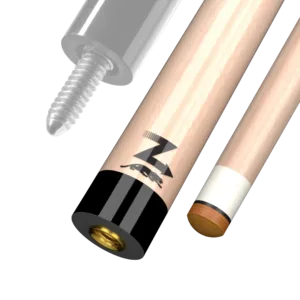
- Tip: Zan Plus2 M (medium hardness)
- Ferrule: IG Ferrule, engineered to complement the carbon core’s deflection profile
- Tip Plate: IG Tip Plate, designed to optimize contact energy transfer
- Joint options: Mezz Wavy Joint or United Joint (modified 5/16×14)
- Core: Vibration-dampening inner core
- Price: $595
The IG Ferrule and IG Tip Plate are not afterthoughts. They are integral to the shaft’s character. The ferrule is engineered to work with the carbon outer layer to reduce high-frequency vibration at impact, while the tip plate creates a smooth, consistent energy transfer surface between the tip and the carbon body. Together they contribute significantly to the warm, solid hit the Ignite is known for, a point that most brief reviews overlook entirely.
The vibration-dampening core plays an equally important role. In most carbon fiber shafts, the hollow or minimally dampened interior transmits vibration very efficiently, which is part of what gives some CF shafts their sharp, clinical ping on contact. The Ignite’s core absorbs a portion of that high-frequency vibration, allowing the lower, more resonant feedback tones to dominate. The hit feels fuller as a result.
Hit, Feel, and Sound: Does It Really Hit Like Wood?
This is the question every maple-trained player asks, and it deserves an honest, detailed answer.
The Mezz Ignite does not hit exactly like wood. No carbon fiber shaft does. What it does is come closer than virtually any other carbon shaft currently on the market. On a standard center-ball stroke, the sound is noticeably warmer and more rounded than a Predator REVO. Where the REVO produces a crisp, high-pitched contact note, the Ignite produces something closer to the solid thud of a quality maple shaft. Players who have used both consistently describe the Ignite’s sound as more satisfying and less mechanical.
The flex profile contributes to this sensation. The Ignite allows a very slight, controlled flex at impact, replicating the micro-bend that a stiff maple shaft produces during contact. This is not noticeable deflection in the sense that it throws the cue ball off line. It is the kind of subtle give that communicates shot information back through the grip hand. On draw shots and follow shots with pace, this feedback is genuinely informative and confidence-inspiring.
For players coming directly from the Mezz WX700, the transition to the Ignite is among the smoothest of any carbon fiber upgrade available. The character of the hit is familiar enough that muscle memory translates almost immediately.
Deflection Analysis: Mezz Ignite vs Revo, WX900, and WX700
Understanding where the Ignite sits in the deflection hierarchy is essential for setting realistic expectations. Here is how it compares to the most relevant benchmarks:
- Mezz WX900: Considerably more deflection than the Ignite. The WX900 is a wood shaft, and even the best Japanese maple produces more deflection than carbon fiber at equivalent diameter.
- Mezz WX700: The Ignite measures slightly less deflection than the WX700. This makes the transition from WX700 to Ignite the most natural upgrade path for Mezz loyalists.
- Predator REVO: The REVO is engineered to produce the lowest deflection of any commercially available shaft. The Ignite has measurably more deflection than the REVO, though many players find the practical difference at the table smaller than the raw numbers suggest.
The key takeaway: the Ignite is not competing with the REVO for the title of lowest deflection. It is competing for the title of best overall playing experience for the player who values feel alongside accuracy. On that measure, many experienced players prefer the Ignite.
For a deeper look at how these shafts stack up side by side, see our full Predator REVO vs Mezz Ignite vs Cynergy carbon shaft comparison.
12.2mm vs 12.6mm: Stiffness and Weight Differences
Mezz offers the Ignite in two diameters, and the difference between them is more significant than the 0.4mm gap suggests.
The 12.6mm Ignite is noticeably stiffer and heavier than the 12.2mm. It produces less deflection due to the increased diameter and mass, and the hit feels harder and more authoritative. Players with a powerful, piston-style stroke often prefer the 12.6mm for its stability on hard shots and break-style power strokes.
The 12.2mm Ignite is the better choice for most players. It offers a more refined feel on finesse shots, slightly more flex feedback, and a hit that sits closer to the wood-feel profile that makes the Ignite distinctive. If you are coming from a standard maple shaft, the 12.2mm is almost certainly the correct starting point.
If you are curious how the Ignite’s design philosophy compares to Mezz’s wood shaft lineup, our Mezz WX Sigma Shaft guide covers the full range of Mezz precision shaft engineering.
Maintenance and Durability: Resistance to Dinks and Warping
One of the most practical advantages of any carbon fiber shaft is its resistance to the damage that wood shafts accumulate over time. The Ignite is no exception.
Warping is simply not a concern. Carbon fiber does not respond to humidity, temperature changes, or storage conditions the way maple does. A wood shaft left in a hot car or a humid pool room can warp. An Ignite shaft will not.
Dinks and surface dings are far less likely to affect the Ignite’s playing surface than a wood shaft. The carbon exterior resists the small impacts and table contact that gradually roughen and compromise wood grain. The slick, consistent surface of the Ignite also requires significantly less maintenance: no sanding, no burnishing, no shaft conditioner routines.
Cleaning is straightforward. A slightly damp microfiber cloth removes chalk and oil buildup. The surface stays consistent session after session, which is one of the underrated performance advantages of carbon fiber: your shaft plays the same on day one as it does after two years of regular use.
Joint Options: Mezz Wavy vs United (5/16×14 Modified)
The Ignite is available with two joint options, and choosing the right one depends entirely on which butt you are pairing it with.
The Mezz Wavy Joint is the native option for pairing the Ignite with a Mezz Exceed butt or any other Mezz butt that uses the Wavy joint system. The Wavy joint provides a secure, precise fit with excellent vibration transfer characteristics between shaft and butt.
The United Joint (model IG12.2U) uses a modified 5/16×14 thread pattern that is compatible with Joss and Schon cues, among others. This makes the Ignite a realistic upgrade option for players who own quality American-made butts and want to add carbon fiber performance without replacing their entire cue.
When pairing with a Mezz Exceed butt via the Wavy joint, the combination is seamless both mechanically and aesthetically. The Ignite feels like a native component of the Exceed system, not an afterthought.
Tip Considerations: The Zan Plus2 M and Alternatives
The Ignite ships with the Zan Plus2 M tip, a medium-hardness layered tip from one of Japan’s most respected tip manufacturers. It is a quality tip by any objective measure, but player feedback consistently points to one issue: for many playing styles, medium-hardness on a carbon fiber shaft feels harder in practice than medium-hardness on wood.
Carbon fiber transmits less natural dampening than maple, which means the tip bears more responsibility for absorbing contact energy and generating spin. Many Ignite owners find that stepping down to a softer tip, such as a Kamui Black Soft or a Zan Plus2 S, unlocks noticeably more English and draw response without sacrificing cue ball control.
This is a straightforward modification and worth experimenting with early in your ownership. The Zan Plus2 M is an excellent starting point, but do not hesitate to re-tip if you find spin response underwhelming.
Price and Value: Is the $595 Cost Worth It?
At $595, the Mezz Ignite is priced at the upper end of the premium carbon fiber shaft market. Whether that investment is justified depends on what you are comparing it against.
Against a high-grade Japanese maple shaft like the WX700 or WX900, the Ignite costs more upfront but delivers significantly longer functional life, requires far less maintenance, and eliminates the ongoing risk of warping or damage. Over a five-year ownership horizon, the per-session cost difference narrows considerably.
Against other carbon fiber shafts at similar price points, the Ignite’s unique value proposition is clear: it is the carbon shaft that prioritizes playing feel alongside performance metrics. If low deflection above all else is your goal, there are shafts that will outperform the Ignite on that single axis. If you want a carbon fiber shaft that you will actually enjoy playing with, day in and day out, the Ignite makes a compelling case at its price point.
Pro Cue Shop carries the complete Mezz Ignite range, fully authentic and warrantied, with delivery across the USA, Japan, China, and Australia. Shop Mezz Shafts at Pro Cue Shop.
Final Verdict: Who Should Buy the Mezz Ignite Shaft?
The Mezz Ignite carbon fiber shaft is the right choice for a specific, well-defined player profile. If you match the description below, it deserves a place at the top of your shortlist.
Buy the Mezz Ignite if you:
- Are transitioning from a Japanese maple shaft, particularly the WX700 or WX900, and want to preserve the character of that hit
- Value feel and feedback as much as raw deflection numbers
- Want a carbon fiber shaft you can play with immediately, without a long adjustment period
- Are pairing with a Mezz Exceed butt or a Joss/Schon butt via the United joint
- Play in varied environments where warping and humidity are practical concerns
- Are ready to invest in a shaft that will perform consistently for years without maintenance
Consider alternatives if you:
- Prioritize absolute minimum deflection above all other performance factors, in which case the REVO may be a better technical fit
- Prefer a softer, more pillowy hit feel, in which case a premium leather-tip wood shaft may still suit you better
The Ignite is not trying to be the most technically extreme carbon fiber shaft. It is trying to be the most playable one. For a large portion of serious pool players, that distinction makes all the difference.
Frequently Asked Questions: Mezz Ignite Carbon Fiber Shaft
Does the Mezz Ignite shaft hit like a wood shaft?
It comes closer than any other carbon fiber shaft currently available. The vibration-dampening core, IG Ferrule, and ICLT construction produce a warmer, rounder hit sound and a more familiar flex profile than most CF shafts. It does not replicate wood exactly, but the similarity is close enough that maple-trained players typically adjust within a single session.
What is the difference between the Mezz Ignite 12.2mm and 12.6mm?
The 12.6mm version is stiffer and heavier, with slightly less deflection due to increased diameter and mass. It hits harder and suits players with more aggressive, power-oriented strokes. The 12.2mm is more refined, with better finesse-shot feedback, and is the recommended starting point for most players.
How does the Mezz Ignite compare to the Predator REVO?
The REVO produces lower deflection. The Ignite produces a warmer, more wood-like hit with more tactile feedback. Players who prioritize deflection numbers tend to prefer the REVO. Players who prioritize overall playing experience and feel often prefer the Ignite. See our full REVO vs Ignite vs Cynergy comparison for a detailed breakdown.
What tip comes with the Mezz Ignite, and should I change it?
The Ignite ships with the Zan Plus2 M tip. It is a high-quality layered tip, but many players find that a softer variant (such as a Zan Plus2 S or Kamui Black Soft) provides better English and draw response on a carbon fiber shaft. Experimenting with tip hardness early in ownership is strongly recommended.
Which joints does the Mezz Ignite support?
The Ignite is available with the Mezz Wavy Joint for native compatibility with Mezz Exceed butts, and the United Joint (modified 5/16×14) for compatibility with Joss, Schon, and other compatible cue butts.
Where can I buy the Mezz Ignite shaft with a warranty?
Pro Cue Shop carries the complete, authentic Mezz Ignite range with full warranty coverage and ships to the USA, Japan, China, and Australia. View all Mezz shafts here.
Related Reading:


We use cookies to improve your experience. By continuing, you agree to our cookie policy.
I Accept
We usually reply instantly
Your Cart
Add $999.00 more to get free shipping!

Predator BK Rush USA Break Cue No Wrap
Price range: $949.00 through $974.00
Predator P3 Painted Blue Pool Cue No Wrap Radial
Price range: $1,289.00 through $1,533.00
Predator P3 Painted Blue Pool Cue Leather Luxe Radial
Price range: $1,369.00 through $1,613.00
Predator P3 Fourth of July No Wrap Pool Cue
Price range: $1,289.00 through $1,533.00
- Email:support@procueshop.com
- Phone:+1 701 214 0492
All Categories
Search
Predator BK Rush USA Break Cue No Wrap
Price range: $949.00 through $974.00Predator P3 Painted Blue Pool Cue No Wrap Radial
Price range: $1,289.00 through $1,533.00Predator P3 Painted Blue Pool Cue Leather Luxe Radial
Price range: $1,369.00 through $1,613.00